
Buying a vintage Heuer is not only about choosing between Carrera, Autavia and Monaco. Each family includes different references, movements, dials, bezels and case styles. Two watches with the same model name can have very different levels of originality and value.
The safest approach is to judge the whole watch. The reference, dial, hands, bezel, case, movement and service history should all make sense together. A rare model with several incorrect parts is often a worse purchase than a more common example in honest condition.

Collectors normally use the term vintage Heuer for watches produced before the company became TAG Heuer in the mid-1980s.
Most examples carry the Heuer name on the dial, movement, case or caseback. Transitional watches also exist, so the logo alone is not always enough to confirm the production period.
Check the complete configuration:
Vintage Heuer is best known for racing chronographs, early automatic movements and clear, functional designs. Carrera, Autavia and Monaco are the most recognised model families.
Choose a Carrera if you prefer a clean, balanced chronograph that works well for regular wear.
Choose an Autavia if you want a more technical design with a rotating bezel and stronger tool-watch character.
Choose a Monaco if you prefer a bold square case and one of Heuer’s most distinctive designs.
There is no single correct choice. The best first Heuer is usually a well-documented watch in honest condition, not the rarest reference you can afford.
The Carrera is one of Heuer’s cleanest chronograph designs.
Early models often have compact round cases, narrow bezels, sharp lugs and simple two- or three-register dials. The layout was designed around readability, which is why the watch still looks balanced today.

Start with the dial.
Check:
A refinished dial may look clean, but the lettering can be too thick or the spacing may not match documented examples.
The hands should also match the reference. Their length, shape, colour and lume are important. Incorrect replacement hands are common on watches that have been serviced several times.
Carrera cases usually have clearly defined lugs and surfaces. Heavy polishing can soften the edges and change the proportions. Normal scratches are often less concerning than a case that has lost its original shape.
The movement must correspond with the reference. Early Carreras used several hand-wound chronograph calibres, including movements from the Valjoux family.
Check that the chronograph starts, stops and resets correctly. Winding should feel smooth, and the movement should not show signs of corrosion or careless repair.
The Autavia has a stronger technical character than the Carrera.
Its name combines automobile and aviation, and most wristwatch versions use a rotating bezel. Depending on the reference, the bezel may display minutes, hours, GMT or tachymeter scales.
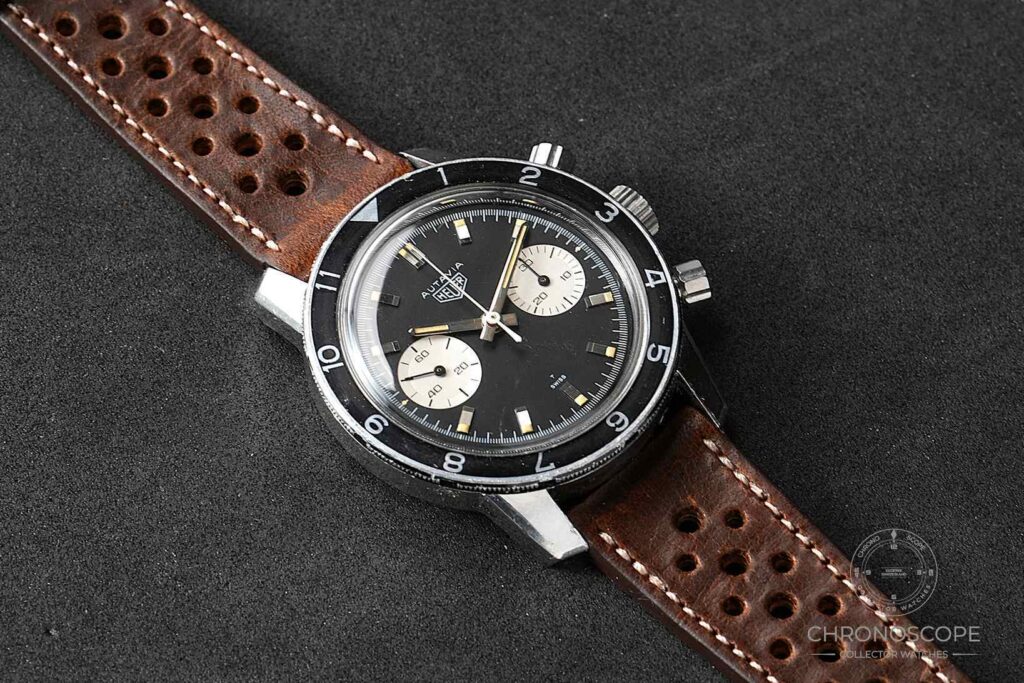
The bezel is one of the most important parts.
Check:
A bezel can look correct while belonging to another Autavia variation. Original bezels can also be difficult and expensive to replace.
The dial and hands vary considerably between references. Compare the watch with documented examples of the exact reference, not only the same model family.
Look at:
Autavia cases also differ between early hand-wound models and later automatic versions. Check the original brushing, case edges, crown position, pusher shape and caseback markings.
Automatic Autavias from the Calibre 11 and Calibre 12 period can require specialist servicing. A working chronograph may still contain worn parts or poor previous repairs.
The Monaco is the most visually distinctive of Heuer’s major vintage chronographs.
Its square case, bold dial and early automatic movement made it unusual when it was introduced. It remains one of the easiest Heuer models to recognise.

Case condition matters greatly.
The square shape makes polishing easy to notice. Check the corners, side surfaces, case thickness and transitions between brushed and polished areas.
A heavily polished Monaco can lose the sharp architecture that gives the watch its character.
The dial should be checked for:
A very clean dial is not automatically original. Some restored dials look convincing in ordinary photographs.
Early automatic Monaco models are associated with the Calibre 11 family and related versions. These are modular chronographs and need a watchmaker who understands the construction.
Before buying, ask:
Calibre 11 is an important part of Heuer’s automatic chronograph history.
The construction combines an automatic base movement with a chronograph module. Calibre 12 introduced later technical changes.
For a buyer, the movement name is not enough.
Confirm that:
A famous movement can still be expensive to repair when maintenance has been neglected.
The dial is often the most important individual component of a vintage Heuer.
Check:
Natural ageing can be attractive. Moisture, corrosion and missing printing should not be presented as desirable patina.
Case condition is also important because Heuer used many distinctive shapes. Light wear on an original case is often preferable to a heavily polished case with softer lines.
For Autavia models, the bezel can have a major effect on value. A correct original bezel may be difficult to find, while an incorrect bezel can make the watch appear to be another reference.

Not always.
A watch with service parts can still be reliable and enjoyable to wear. A replacement crystal or crown usually has less impact than an incorrect dial, bezel or movement.
Ask:
The main issue is transparency. Service parts should be described clearly.
A vintage chronograph needs proper maintenance.
Before buying, ask:
A claimed service without documentation should be treated as unconfirmed.
Do not assume that a vintage Heuer is water-resistant, even if the model was originally designed for sport or professional use.
There is no single price for a Carrera, Autavia or Monaco.
Value depends on:
A cheaper watch may need a correct bezel, movement repair, replacement hands or a complete service. These costs can quickly remove the apparent saving.
Compare complete watches, not only asking prices.
Before buying, confirm:
Ask for more photographs when an important detail is not visible.

There is no single best model. Carrera suits buyers who prefer a clean chronograph, Autavia has stronger tool-watch character, and Monaco offers the most distinctive design.
No. Vintage Heuer normally refers to watches made before the TAG Heuer period. Transitional models should be checked by reference, movement and configuration.
A clearly documented Carrera or Autavia with an original dial, honest case and serviced movement can be a good first purchase.
Yes, when properly maintained. Mechanical chronographs require regular service, and some automatic movements need a specialist.
The exact reference, dial, bezel, case condition, movement and originality all matter. A correct original bezel can have a large effect on value.
A redial may be acceptable for a less expensive wearing watch, but it should be disclosed and valued differently from an original dial.
ChronoScope offers selected vintage Heuer chronographs, including Carrera, Autavia, Monaco and other collector references.
Each watch is assessed for reference, originality, condition and technical state before it is offered.
I personally help collectors source specific vintage and rare watches.
Send me your request and I’ll get in touch with you directly.

Our business is built on your trust. We guarantee all our timepiece are authentic and as described / pictured or you will receive a full refund.
We guarantee the functionality of our watches. Please refer to the guarantee period stated in each product description. All guarantees are subject to the General Terms and Conditions (GTC)
Excluded from the warranty for defects are the accuracy, waterproof / water resistance, wear of the wristband and general wear and tear, scratches on the wristband or case, and damage to the glass / crystal.
CHRONOSCOPE is not liable for defects to the products caused by improper handling by the buyer or any third parties, as well as for general wear and tear.
The warranty for defects is null and void if the customer or a third-party attempt to repair the products themselves, unless prior specific written agreements have been made with CHRONOSCOPE
The compensation for the violation of contractual obligations by CHRONOSCOPE is limited to the amount paid by the buyer.
Due to the nature of vintage timepieces, all watches are sold as is. We will accurately describe the current condition and working order of all watches we sell to the best of our ability. Given that vintage watches are antique collector items, we do not provide any guarantee on movement accuracy, water-proofing or any other mechanical guarantee unless it is mentioned in the product description.
We check all watches when listing the watch for sales, and again before shipping. In rare cases, shipping can cause the movement problems. Therfore, please check all functions of the watch upon receipt. Should you find any issues, please notifiy us by email without dealy.
In the unlikely case you should not be satisfied with the watch you receive, contact us and we will work towards finding a solution.
We always looking for interesting vintage and contemporary watches and offer fair values. Please send us some pictures & a discription of what you have, and we will be glad to come back to you with an offer.
If you buy a watch from us, we can also offer a trade-in option.
Swiss Vintage Chronographs, for example Omega, Longines, Breitling, Heuer, Leonidas, Angelus, Excelsior Park, Zenith, Wakmann, Wittnauer but also other lesser known Swiss brands.
Swiss Vintage Watches: for example dives watches of various brands, but also dress watches in steel or gold
Contemporary Swiss Watches such as Rolex, Tudor, Omega, Zenith etc.
Quartz watches only from Rolex, Tudor, Omega, Patek Philippe, Audemars Piquet, IWC Vacheron Constatin and other High-End Swiss brands
Digital watches, only from Omega, Girard Perregaux and a few other High-End Swiss Brands
Ladies watches
Pocket watches
Japanese watches (not that they are not good, but i dont have much knowledge there)
Quartz & watches
We need pictures and a brief description of the watches that you intend to sell
Your price expectation, if you already have any
Send us your information by email to info@chrono-scope.ch
We will be on summer holiday from July 22 to August 12. During this period, our availability will be limited and responses may take longer than usual.
Thank you for your understanding!
Wir garantieren die Echtheit und die Funktion der Uhr *
Sollte die Uhr nicht wie beschrieben und abgebildet sein, haben Sie das Recht, sie an uns zurückzusenden und wir erstatten Ihnen den vollen Betrag zurück *.
Wir bieten sichere Transaktion und Versand begrenzt auf den Betrag vom Käufer bezahlt.
* Bitte beachten Sie die Garantie- und Rückgabebedingungen sowie die Allgemeinen Geschäftsbedingungen.